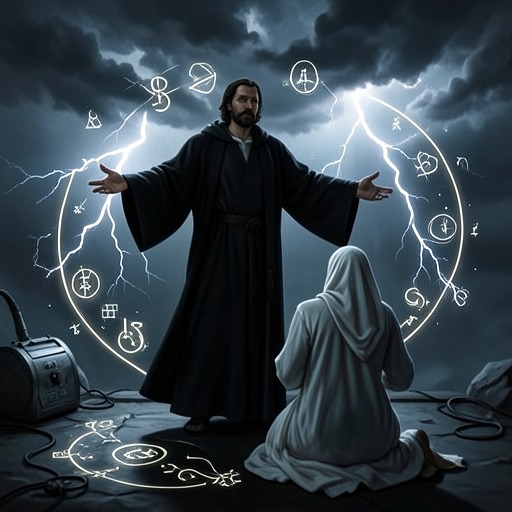
Priests of Hedomas
Bride of AlvarThe Priests of Hedomas are the clerical order attached to King Saul’s palace and the worship of Hedomas. Their authority is not merely devotional: they participate in secret state missions, interpret or manufacture prophecy, conduct sacrificial rituals, and help define Alvar as a monster whose existence must be destroyed. Through them, religion becomes one of the principal instruments by which Saul’s tyranny converts fear, blood, and political command into apparently sacred law.
Position in Saul’s Court
The priests are a constant presence in the palace, where they serve Saul’s god and surround the king’s government with religious ceremony. At a classified meeting attended by Alvar and Fletch, a priest in a red hood enters after Saul has summoned the others and insists that the mission remain secret. Saul presents the gathering as an operation to obtain a possession for himself, then delegates its explanation to Hyphus, demonstrating the order’s role in translating royal desire into an authorized religious or strategic purpose.
The order’s proximity to Saul gives it influence beyond ordinary worship. Alvar regards the priests with hatred, believing them wicked and accusing them of inventing half their prophecies to satisfy their appetite for wealth and power. This judgment makes the priesthood part of the same corrupt political structure as Saul: its claims to divine knowledge are presented as a means of accumulation and control rather than as a trustworthy search for truth.
Prophecy, Secrecy, and the Memori Mission
Hyphus explains that rumors have reached the palace of a great Memori discovered in the north by the Sylphs. Saul therefore orders an attack on the temple to seize the object and return it to him. The mission is treated as highly classified, and the presence of a priest is significant enough for Fletch to question why Saul has not simply sent him and Scarbrow. The episode places the Priests of Hedomas at the junction of intelligence, religious knowledge, and military action: they know how to frame an object of spiritual importance as a possession of the king.
The order’s methods also depend on restricted speech and controlled access to knowledge. Saul commands Fletch not to speak unless addressed, while Hyphus delivers the explanation in a smooth, authoritative voice. The arrangement makes religious expertise a gatekeeping function. The priesthood does not simply report what the world means; it determines who may know, who may speak, and which sacred object may be taken by force.
Hyphus, Alvar, and the Ritual of Violence
Hyphus has a personal history with Alvar: in another life, the two had been family. After Alvar has been reduced to servitude under Saul, Hyphus claims, “I am your master now, Cursed,” and treats Alvar’s Cursed blood as the source of a new hierarchy in which the former relation between them is replaced by domination. Alvar rejects the claim, but the exchange shows how the priesthood uses religious classification to transform bodily difference into political subordination.
Hyphus’s cruelty becomes explicit in his treatment of a slave girl who has entered Alvar’s confinement and begged to be killed. Alvar wants to help her, yet Hyphus announces that Alvar must attend a ritual in which he will spill her virtue blood on Hedomas’s altar. The ceremony turns the girl’s body into an offering and Alvar’s forced presence into a spectacle of power. Hyphus further taunts Alvar by promising that he will always possess what Alvar cannot, making ritual sacrifice both religious violence and a deliberately intimate humiliation.
Alvar’s transformation into the Cursed is made part of this coercive structure. Hyphus watches as the change tears through Alvar’s flesh and wings erupt from his back, then uses the transformation as proof of the status he claims to impose. The priesthood thus participates in the making of the “monster” it condemns: it isolates Alvar, names him through the language of curse and impurity, and then treats the fear produced by that naming as justification for further violence.
Religious Condemnation and Rival Faith
The Priests of Hedomas publicly reinforce the hatred directed at Alvar from childhood. When villagers reject him, the priests chant against him, calling for the gods to destroy him and for his Curse to die with him. Their liturgy supplies a collective vocabulary for fear, converting the crowd’s anger into a religious verdict. There is no pity in the scene, only expulsion and the demand that Alvar be killed before he grows into a greater threat.
This doctrine conflicts with Alvar’s secret worship of Elias, the God of Light. Alvar believes that Elias commands men to love and respect women and to treat them as equals, a moral standard he uses to distinguish himself from Saul’s lust and from the priests’ sacrificial cruelty. Later, when Saul explains that Alvar’s blood is valuable to a sorceress and confines him in the pit, Alvar invokes Elias and wishes that Saul be destroyed by fire. Saul answers by denying the gods and proclaiming himself the new god of Axus. The exchange exposes the rivalry between three forms of authority: Alvar’s ethical faith, the priests’ institutional religion, and Saul’s openly personalized political theology.
The order’s power also helps explain why a threatened marriage can be treated as a matter of international survival. Alvar’s proposed union with Lucy Hammond is tied to a diplomatic promise intended to prevent Axus from attacking Earth, while marriage would allow Alvar to declare Earth humans protected. Against this political logic, the Priests of Hedomas represent the religious world that makes coercion appear legitimate: blood, prophecy, kingship, and sacrifice are repeatedly joined so that individual consent becomes less important than the order’s sacred and political hierarchy.
Narrative Function and Significance
The Priests of Hedomas function as the institutional face of a world in which divine language conceals rather than restrains violence. Their red robes, secret councils, prophecies, chants, and altars connect the palace to the village crowd and the prison pit. They are not shown as a separate spiritual counterweight to Saul; Alvar’s assessment places them inside the machinery of wealth, power, and persecution that sustains his reign.
Their importance lies in the contrast they create with Alvar’s conduct. Although he is labeled Cursed and feared as a monster, he refuses to mirror Saul’s lust, resists Hyphus’s claim to mastery, and tries to protect a vulnerable slave girl. The priesthood’s sacred vocabulary therefore exposes an inversion at the center of the story: those who speak for Hedomas call for destruction, while the condemned figure reaches toward mercy. Against that inversion, Alvar’s allegiance to Elias offers a competing idea of religion grounded not in ritual possession or public condemnation but in equality, restraint, and responsibility.